
The History of San Miguel de Allende: From Frontier Outpost to World Heritage City
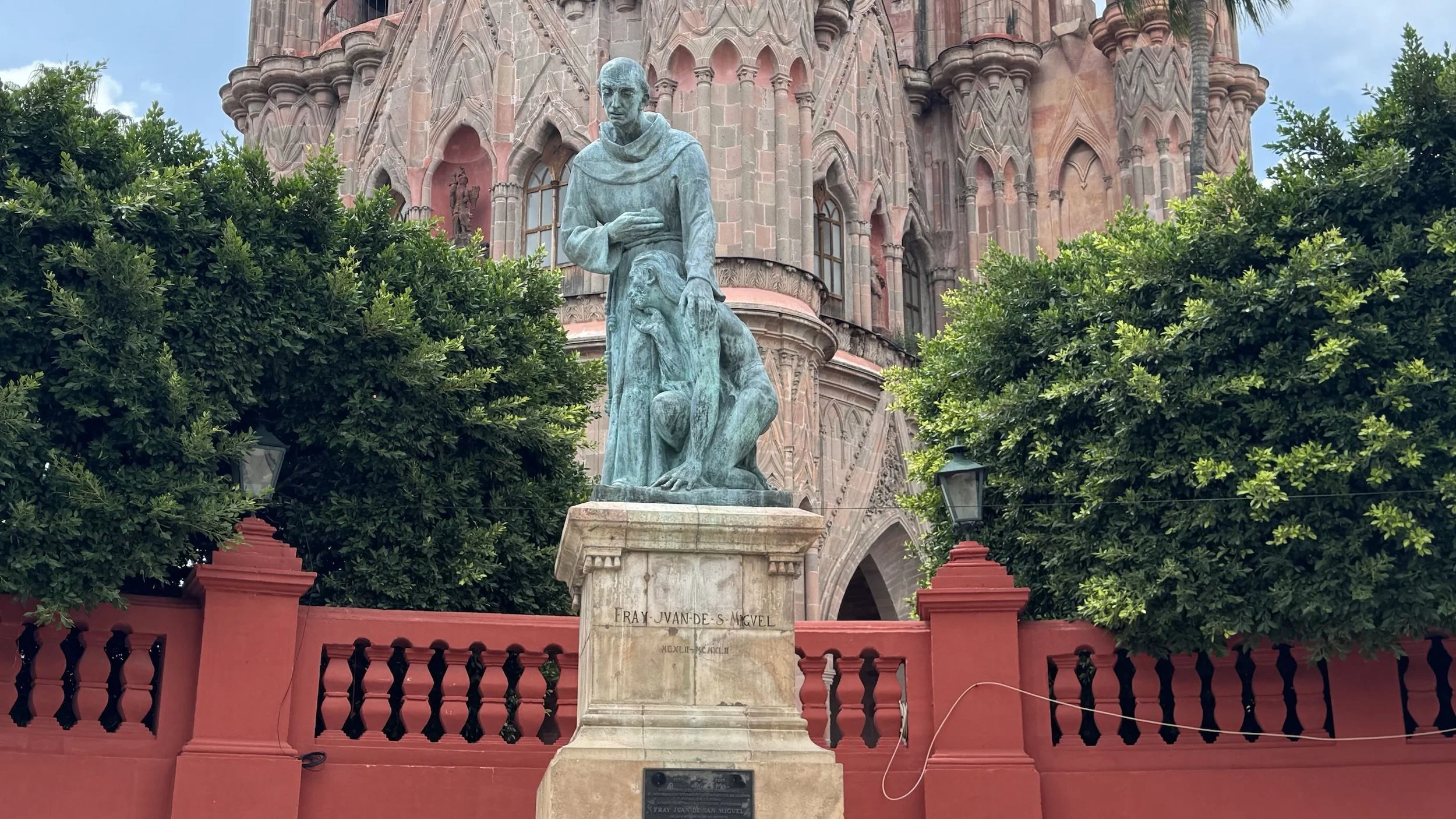
The statue of Fray Juan de San Miguel honors the Franciscan friar who founded San Miguel in 1542.
Visitors often fall in love with San Miguel de Allende at first sight. The pink spires of the Parroquia rise above the city skyline, colorful colonial homes line narrow cobblestone streets, and nearly every corner reveals another church, plaza, or hidden courtyard waiting to be discovered.
What many people don’t realize is that San Miguel almost disappeared.
Over the past five centuries, the city has experienced periods of prosperity, revolution, decline, and remarkable renewal. It began as a small Spanish settlement on the northern frontier of New Spain, grew into an important commercial center, played a pivotal role in Mexico’s fight for independence, nearly faded into obscurity during the nineteenth century, and was ultimately rediscovered by artists who helped reintroduce it to the world.
Today, San Miguel de Allende is recognized as one of Mexico’s most beautiful cities and one of its most desirable places to live. Understanding how it reached this point makes every walk through its historic streets even more meaningful.
Before the Spanish
Long before the Spanish arrived, the valleys surrounding present-day San Miguel de Allende were home to Indigenous peoples who hunted, farmed, and traded throughout central Mexico. The region sat near the frontier between the more densely populated civilizations of central Mexico and the vast territories to the north.
Among the peoples who lived here were groups collectively known as the Chichimecas. Far from being a single tribe, they were made up of several independent nations that knew the rugged landscape intimately and resisted Spanish expansion for decades. Their determination made this one of the most difficult frontiers for the Spanish to settle.
Today, little evidence of these early communities remains within the city itself, but their influence shaped the history of the region long before San Miguel existed.
The Founding of San Miguel
San Miguel was founded in 1542 by the Franciscan friar Juan de San Miguel, who established a small mission and settlement intended to protect travelers moving through the region and encourage peaceful relations with the Indigenous population.
The original settlement stood a few miles northeast of the present-day city near the Izcuinapan spring. Although the location provided fresh water, it proved less than ideal. Flooding and conflicts along the frontier led officials to relocate the settlement to higher ground several years later. That new location became the foundation of modern-day San Miguel de Allende.
The city occupied an important position along the Camino Real de Tierra Adentro, the Royal Inland Road that stretched more than 1,500 miles from Mexico City to the rich silver mines of Zacatecas and beyond. Caravans loaded with silver, livestock, textiles, and supplies regularly passed through San Miguel, bringing merchants, craftsmen, soldiers, priests, and travelers from across New Spain.
The steady flow of commerce transformed what began as a frontier settlement into an increasingly prosperous town.
A Colonial City Takes Shape
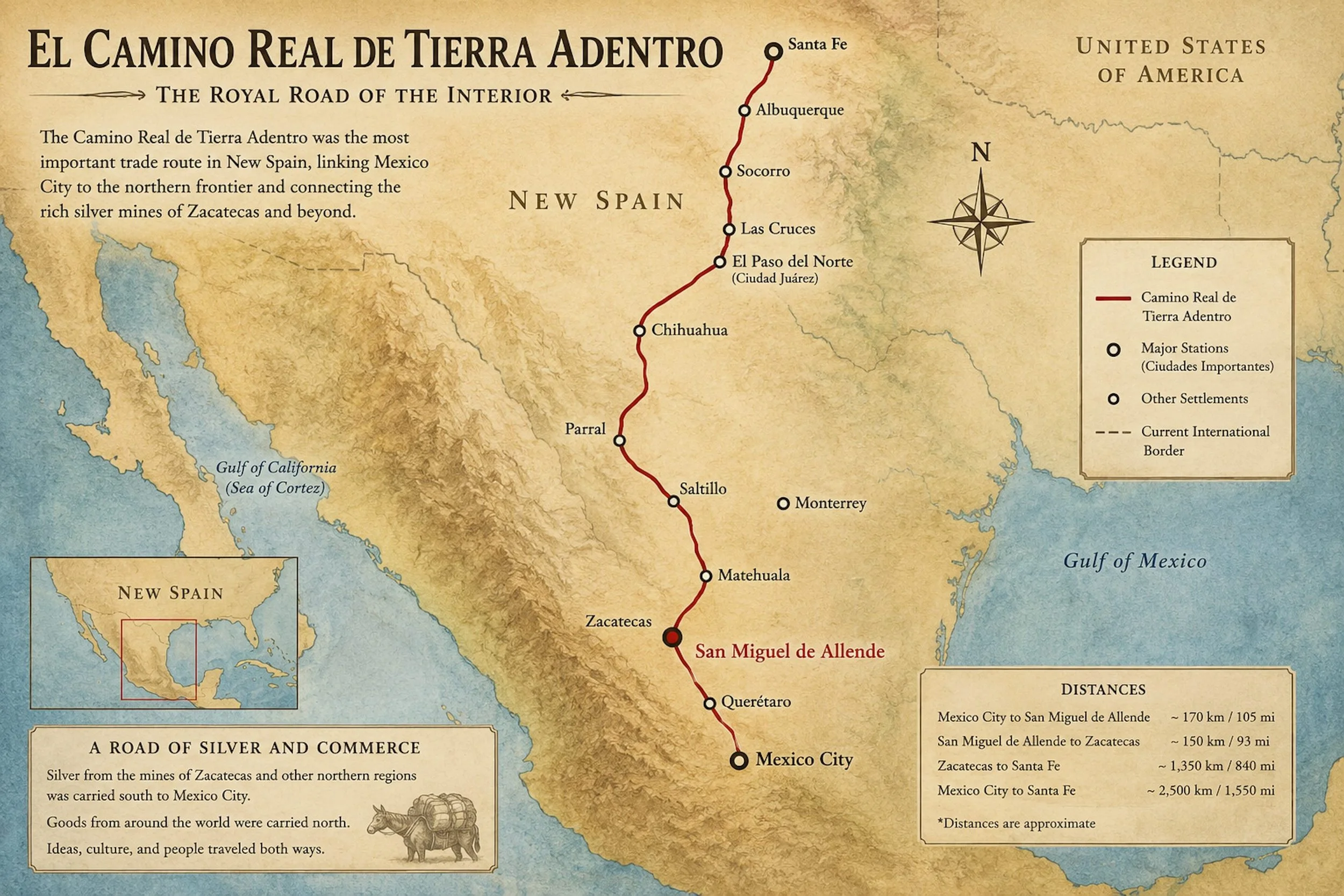
The Camino Real de Tierra Adentro connected San Miguel de Allende to the silver mines of northern New Spain, helping transform the city into a prosperous colonial trading center.
By the seventeenth and eighteenth centuries, San Miguel had become one of the wealthiest communities in central Mexico.
Much of that prosperity came from the nearby silver mines and the trade routes that connected them with Mexico City. Wealthy merchants and landowners built impressive homes around interior courtyards, while religious orders constructed churches, convents, and public buildings that reflected the city’s growing importance.
Many of the buildings that define San Miguel today date from this period.
The Casa del Mayorazgo de la Canal showcased the wealth of one of the city’s most influential families. The Templo de San Francisco displayed extraordinary Baroque craftsmanship in its elaborate stone façade. El Oratorio de San Felipe Neri added another architectural landmark to the growing city, while countless homes featured thick stone walls, carved wooden doors, wrought iron balconies, and shaded courtyards designed for comfort in the central Mexican climate.
These buildings reflected more than prosperity. They demonstrated the skill of local artisans who worked with cantera stone, wood, iron, and plaster to create a city unlike any other in New Spain.
Many visitors first notice the beauty of San Miguel’s architecture without realizing the variety of styles represented throughout the historic center. Spanish Colonial buildings established the city’s foundation, while Baroque, Churrigueresque, Neoclassical, and later Neo-Gothic architecture added new layers over the centuries.
If you’d like to learn more about the buildings that define the city, be sure to read our companion article, The Architecture of San Miguel de Allende: Historic Buildings That Give the City Its Soul.
The Birthplace of Independence
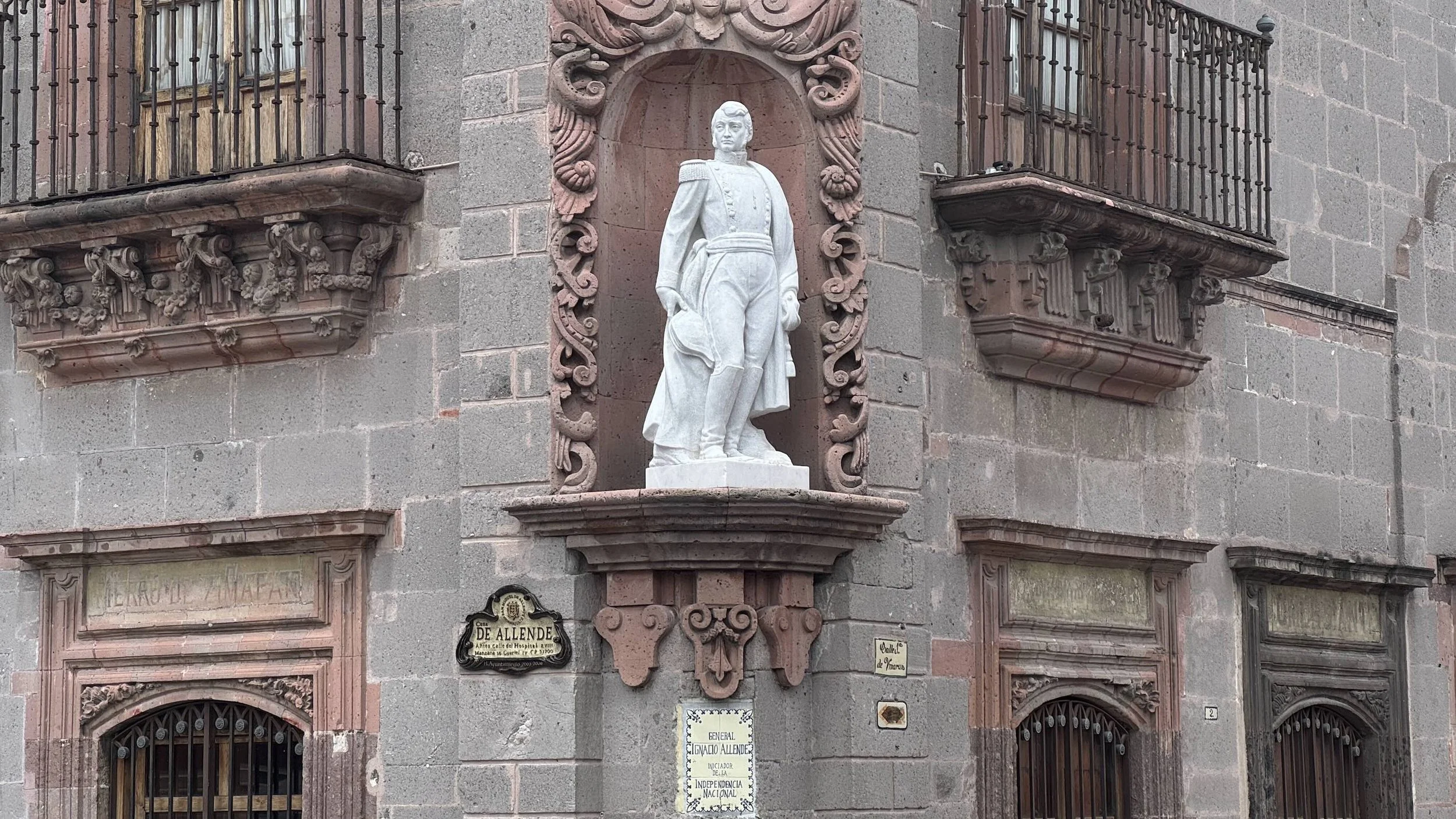
The marble statue of General Ignacio Allende honors San Miguel de Allende’s native son and one of the principal leaders of Mexico’s War of Independence.
San Miguel’s place in Mexican history extends well beyond its beautiful architecture.
In 1769, Ignacio Allende was born in an elegant colonial home just steps from the Jardín Principal. Raised in one of the city’s prominent families, Allende pursued a military career and eventually became a captain in the Spanish army.
As dissatisfaction with Spanish rule spread throughout New Spain, Allende joined a growing circle of reformers who believed Mexico should govern itself. Working alongside the priest Miguel Hidalgo y Costilla, he helped organize what became the opening chapter of Mexico’s War of Independence.
When Hidalgo issued the famous Grito de Dolores on September 16, 1810, Allende stood beside him. While Hidalgo inspired the movement, Allende provided military leadership during many of its earliest campaigns. Although both men were captured and executed less than a year later, they became enduring symbols of Mexico’s struggle for independence.
In recognition of his contributions, the city’s name was officially changed from San Miguel el Grande to San Miguel de Allende in 1826.
Today, Allende’s birthplace serves as the Regional Historical Museum, where visitors can explore both his life and the events that forever changed Mexico.
Years of Decline
The victory for independence came at a heavy price.
Years of conflict disrupted trade, damaged the economy, and left many communities struggling to recover. San Miguel was no exception. The commercial routes that had once brought prosperity shifted elsewhere, mining activity declined, and many wealthy families left the city in search of new opportunities.
Construction slowed dramatically throughout the nineteenth century. Few grand homes were built, and many existing buildings simply continued serving the families who had occupied them for generations.
Ironically, this period of economic stagnation became one of San Miguel’s greatest blessings.
Because there was little pressure to modernize the city, many colonial buildings escaped demolition. Streets remained narrow, churches remained untouched, and countless homes survived with their original character intact.
By the beginning of the twentieth century, San Miguel had become a quiet provincial town. Few people outside Mexico had heard of it.
That was about to change.
Artists Discover San Miguel
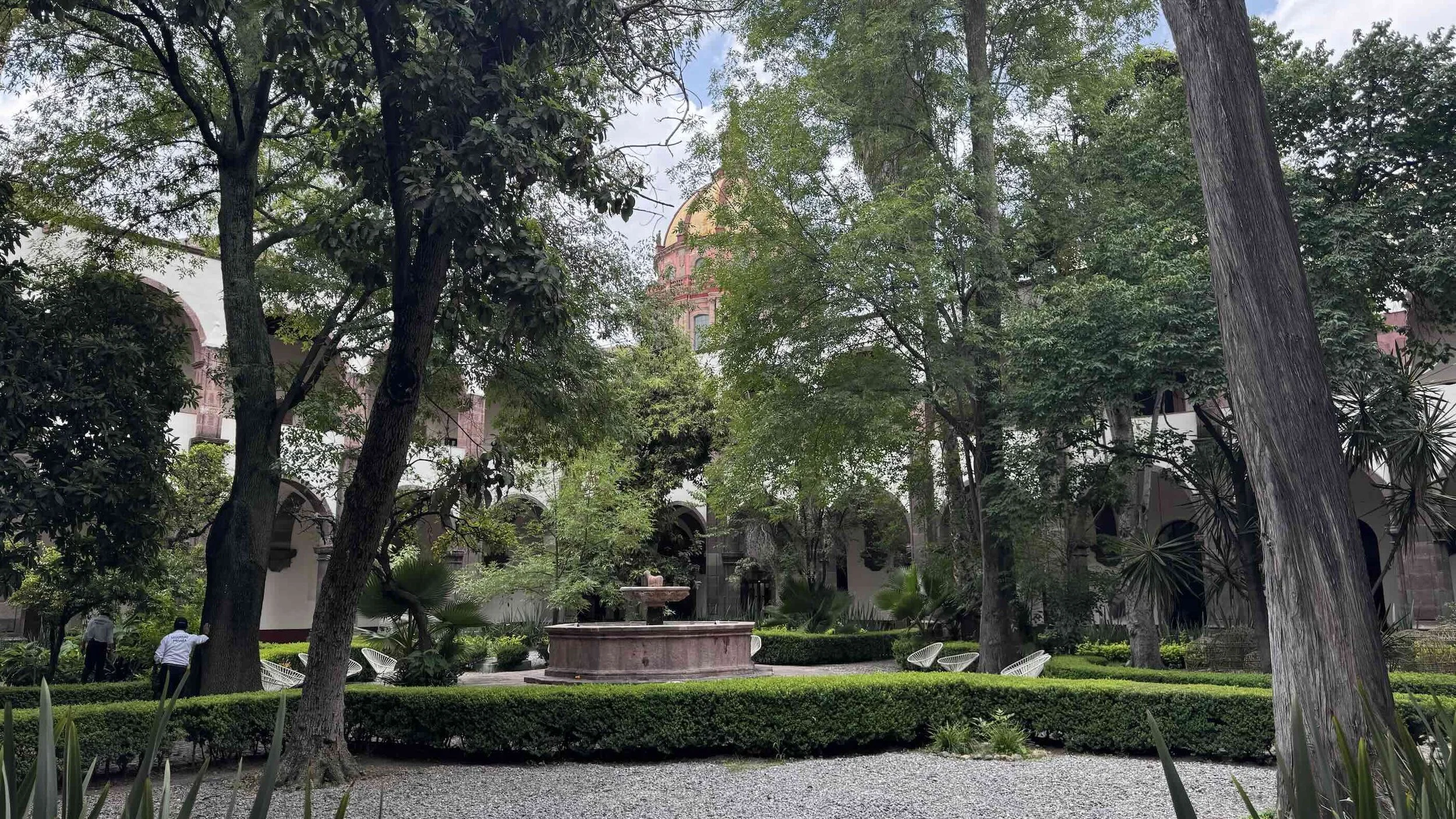
The courtyard of the Centro Cultural Ignacio Ramírez “El Nigromante,” formerly a colonial convent and now one of San Miguel de Allende’s leading cultural centers.
The turning point in San Miguel’s modern history began with art.
In 1938, the former Convent of the Immaculate Conception reopened as Bellas Artes, a cultural center and art school. The beautiful colonial buildings, affordable cost of living, and slower pace of life created an environment unlike the bustling cities where many artists lived and worked.
One of the people most responsible for introducing San Miguel to the world was American artist and educator Stirling Dickinson.
Dickinson first arrived in San Miguel in 1937 while traveling through Mexico. Like so many people after him, he intended only a short visit. Instead, he fell in love with the city and decided to stay. He became an artist, teacher, civic leader, and tireless advocate for San Miguel, helping preserve its historic character while encouraging cultural exchange between Mexico and the United States.
Dickinson believed San Miguel could become an international center for the arts. Working alongside Peruvian artist Felipe Cossío del Pomar and local supporters, he helped establish the Instituto Allende in 1950. The new school welcomed students from around the world to study painting, sculpture, ceramics, printmaking, and other visual arts.
The timing proved almost perfect.
Following World War II, thousands of American veterans returned home with educational benefits provided through the GI Bill. Because the Instituto Allende qualified under the program, veterans could use those benefits to study art in San Miguel de Allende.
Many arrived planning to spend a semester learning to paint or sculpt before returning home.
Instead, they discovered a city unlike any they had known. They found elegant colonial architecture, welcoming local families, year-round sunshine, and a community where artists gathered in cafés, studios, and plazas to exchange ideas. Living expenses were modest, making it possible to devote time to creative work rather than simply earning a living.
Some returned to the United States with stories about the remarkable colonial town they had discovered. Others stayed permanently.
As word spread, painters, photographers, writers, musicians, sculptors, and craftspeople from North America and Europe followed. Galleries opened inside restored colonial homes. Studios occupied former workshops. New exhibitions, concerts, and cultural events brought fresh energy to the city while respecting its historic character.
The influence of those early artists reached far beyond the arts.
Their appreciation for San Miguel’s colonial architecture encouraged restoration rather than demolition. Buildings that might once have been considered outdated became treasured landmarks. Local craftsmanship gained new recognition, tourism slowly increased, and the city’s economy began to recover.
The creative community that emerged during the mid-twentieth century laid the foundation for the San Miguel we know today.
Visitors can still experience that legacy at Bellas Artes and the Instituto Allende, where artists continue to study, teach, and exhibit their work. Hundreds of galleries, workshops, festivals, and cultural events now fill the city’s calendar, making creativity part of everyday life.
Many people assume San Miguel became internationally famous because of tourism.
The opposite is closer to the truth.
Artists came first. Tourism followed. Learn more about how artists transformed San Miguel de Allende
UNESCO Recognition
By the early twenty-first century, San Miguel’s architectural and cultural importance had gained international recognition.
In 2008, UNESCO designated San Miguel de Allende and the nearby Sanctuary of Jesús Nazareno de Atotonilco as a World Heritage Site. The designation recognized the city’s remarkably preserved colonial architecture, its importance in Mexico’s history, and its influence on art and culture.
Today, preservation guidelines help protect the historic center. Renovations are carefully reviewed, traditional materials are encouraged, and new construction must respect the city’s architectural heritage. These efforts ensure that future generations can enjoy the same streets, plazas, churches, and homes that have defined San Miguel for centuries.
San Miguel Today
Today, San Miguel de Allende is home to a diverse community of Mexican and international residents who share an appreciation for its history, culture, and quality of life.
Its historic center remains remarkably well preserved, while surrounding neighborhoods offer everything from restored colonial homes to contemporary residences inspired by traditional Mexican design. The city’s walkable streets, thriving restaurants, galleries, festivals, and year-round cultural events continue to attract visitors and new residents from around the world.
Whether someone comes for a weekend or a lifetime, many discover that San Miguel offers something increasingly rare: a city that has embraced the future without losing sight of its past.
Walking Through History
One of the pleasures of exploring San Miguel de Allende is realizing that history isn’t confined to museums.
It is found in the worn stone steps leading into a neighborhood church. It is carved into the wooden doors of colonial homes. It echoes beneath the arcades of the Jardín and lives on in the courtyards where families have gathered for generations.
Every building tells part of the city’s story.
Some speak of Spanish settlers establishing a frontier town. Others recall wealthy merchants whose fortunes helped build churches and mansions. Still others reflect the vision of artists and educators who recognized the city’s extraordinary beauty and shared it with the world.
The next time you stroll through the Jardín Principal, admire the Parroquia, or wander along Calle Aldama, remember that you’re walking through nearly five centuries of living history.
To continue exploring San Miguel’s remarkable heritage, be sure to read our companion articles on The Stories Behind San Miguel’s Street Names.
Thinking about making San Miguel your home? Our guide, Buying Real Estate in San Miguel de Allende, explains the buying process, legal requirements, and what foreign buyers should know before purchasing a home. Visit our website to learn more about us.